
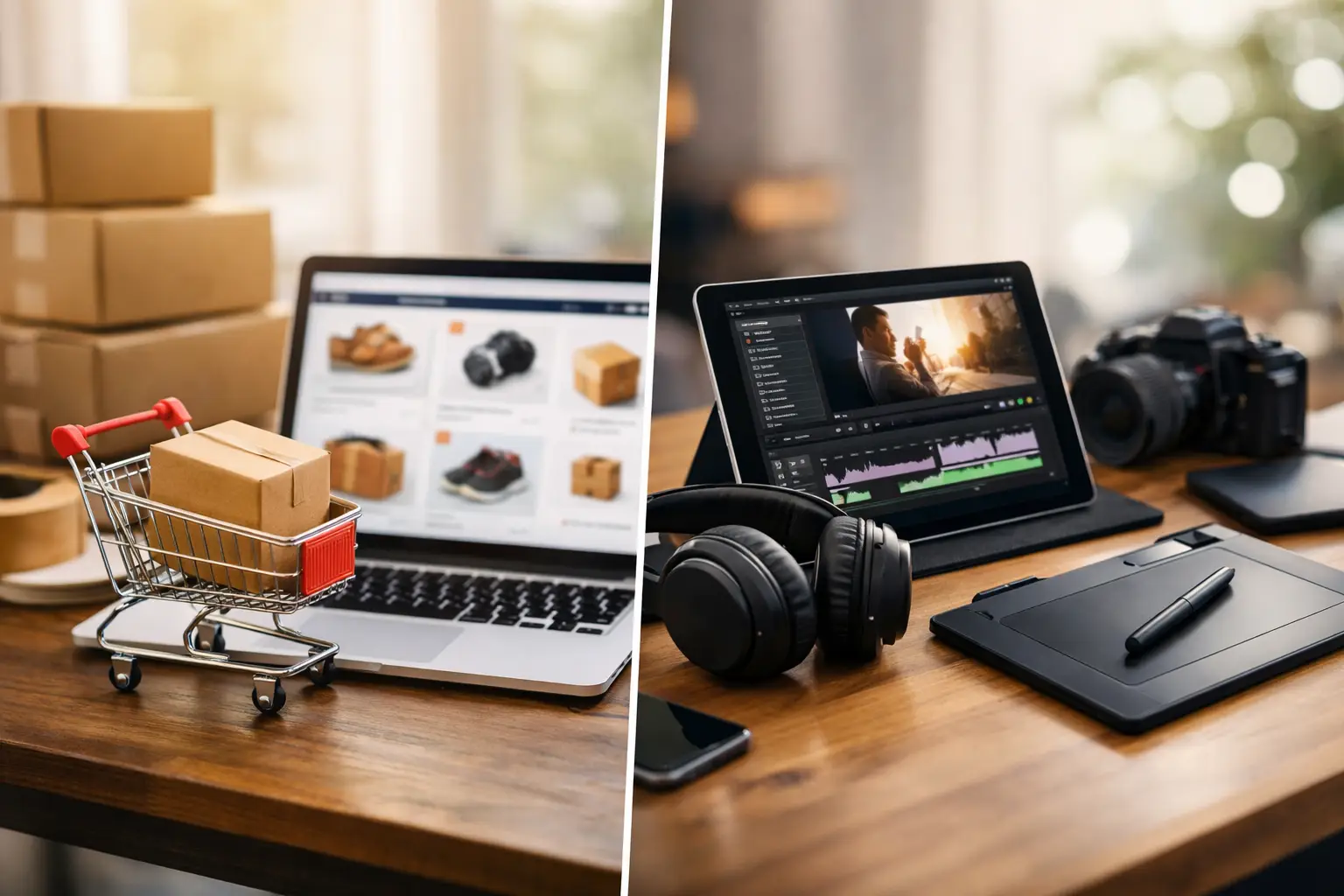
A product sells at 2am while you are asleep. That is the promise behind many online business models, but the work does not disappear – it simply moves. With dropshipping versus digital products, the real choice is whether you want to manage physical-product demand or create an asset people can download repeatedly.
Both can become useful side-income streams. Neither is a shortcut to replacing a salary by next month. For someone building around a job, family life and limited spare hours, the better option is usually the one that matches your skills, budget and tolerance for customer issues.
Dropshipping versus digital products: the core difference
Dropshipping means selling physical items without holding the stock yourself. A customer orders from your online shop, you pass that order to a supplier, and the supplier sends the item to the customer. Your role is to choose products, build the shop, attract buyers and handle the customer experience.
Digital products are files or access-based resources sold online. Think budget spreadsheets, meal planners, Notion templates, printable revision packs, design assets, mini-guides or short video workshops. You make the product once, improve it over time and deliver it automatically after purchase.
The key distinction is simple: dropshipping sells convenience around a physical item, while digital products sell knowledge, organisation, entertainment or a faster route to an outcome. That difference affects your costs, workload, profit margins and ability to grow.
Start-up costs and financial risk
Dropshipping is often marketed as a low-cost business because you do not buy a garage full of stock. That part is true. You can start a basic shop without large inventory costs, but there are still real expenses: ecommerce software, a domain, samples, product photography or creative assets, apps, payment fees and marketing.
The biggest variable is customer acquisition. Many dropshipping shops rely heavily on paid social adverts to generate early sales. Advertising can be useful, but testing products with a small budget can become expensive quickly, especially when you are learning what makes an advert convert. A product might look profitable until refunds, ad spend and delivery issues are included.
Digital products usually cost less to test. You may pay for design software, a selling platform, email tools or a small amount of promotion, but there is no supplier invoice for every sale and no shipping charge. Your main investment is time: researching a problem, making something genuinely useful and creating a clear sales page.
That makes digital products friendlier for cautious beginners. If your first template sells poorly, you have not paid for unsold stock. You can revise the offer, improve the product or reposition it for a more specific customer.
Profit margins are not the whole story
Digital products have attractive margins because the cost of delivering the next copy is tiny. A £12 spreadsheet bundle might leave most of the sale price available after platform and payment fees. However, a high margin means little if nobody sees or wants the product.
Dropshipping margins are usually tighter. If you sell a £35 product, you need to deduct the supplier’s price, postage, transaction fees, advertising costs and any refunds. A healthy-looking turnover figure can hide a modest profit. This is why tracking profit per order matters more than celebrating revenue screenshots.
That said, physical goods can have an advantage in perceived value. Customers may be comfortable paying £40 or £80 for a useful item that solves a clear problem, whereas a generic downloadable guide can feel easy to copy and hard to justify. Digital sellers need to earn the price through specificity and quality.
A practical rule is this: do not choose a model only because the margin looks better on paper. Choose an offer that you can reach the right customers for without spending more than you make.
The time commitment after a sale
This is where the two models separate sharply for a side hustler.
A digital sale can be largely automated. Once the product, checkout and delivery process are in place, a buyer receives access without you packing a parcel or chasing a supplier. You will still answer questions, update files and deal with occasional payment problems, but the workload does not rise in direct proportion to every order.
Dropshipping creates more moving parts. Customers may ask where their order is, request a return or receive an item that does not match their expectations. You are the shop they bought from, so they will expect you to resolve the issue even when the supplier caused it. Long delivery times, poor packaging and inconsistent product quality can damage your reputation fast.
This does not mean dropshipping is a bad model. It means you need reliable suppliers, realistic delivery information and enough time to provide proper customer service. If you only have a few hours a week, digital products are usually easier to maintain.
What each model demands from you
Dropshipping rewards product research, visual marketing and customer-service discipline. You need to spot demand, assess competitors, create compelling product pages and test messages that make people stop scrolling. It can suit someone who enjoys ecommerce, trend research and building a brand around a particular niche.
Digital products reward expertise, empathy and clear communication. You do not need to be the world’s leading expert. You do need to understand a problem well enough to help someone make progress. A freelancer could sell proposal templates. A keen home baker could create a costing calculator. A parent who has organised family finances could create a simple household budget system.
The strongest digital products are not broad. “A guide to productivity” is easy to ignore. “A weekly planning dashboard for NHS shift workers” gives a specific buyer a reason to pay attention. Narrow problems are often easier to market because the benefit is immediately clear.
Customer trust and control
With dropshipping, you control the website and the marketing, but not the full fulfilment experience. You may choose a supplier carefully and order samples, yet their stock levels, dispatch speed and quality checks can change. This is a business risk, not a minor detail.
With digital products, you have far more control over what the buyer receives. You can edit a workbook, add a video walkthrough or fix an error immediately. The challenge is protecting trust in a market full of low-effort downloads. Buyers can tell when a product is recycled advice dressed up with a polished cover.
For either model, build trust before chasing scale. Use honest product descriptions, show exactly what the buyer gets, set clear support expectations and avoid exaggerated income claims. If you are selling to UK customers, also make sure your pricing, refund approach and business records are handled properly. Rules around tax, consumer rights and data protection apply to small online businesses too.
When dropshipping makes more sense
Dropshipping may be the stronger fit if you have a clear product niche and can find suppliers with dependable quality and delivery. It can also suit you if you are willing to learn paid advertising and have a budget you can afford to test without relying on immediate returns.
It works best when you are not simply listing the same viral item as hundreds of other shops. A focused store, useful bundles, better product education and a reliable fulfilment experience give customers a reason to buy from you rather than the cheapest listing they find.
When digital products make more sense
Digital products are often the better first move when cash is tight and your available time is limited. They are especially well suited to people with usable work experience, a hobby, a repeatable process or an audience that already asks them for help.
They also create a longer-term asset. A well-made template or guide can be improved, bundled, used to grow an email list and developed into a larger offer later. You are building something you own rather than relying entirely on a supplier’s catalogue.
The trade-off is that creating a worthwhile product takes thought. Do not spend six weeks making a 70-page ebook before checking whether anyone wants it. Start smaller. Make a useful version for one clear person, put it in front of potential buyers and listen to their questions. Their feedback will show you what to improve next.
A sensible way to choose your first model
If you are undecided, score each option against your real situation rather than your ideal future. Consider your starting budget, spare hours, existing knowledge, interest in customer service and confidence with marketing. Be honest about the part you are willing to learn.
For many beginners, a simple digital product is the lower-risk test. It teaches core online-business skills – identifying a customer problem, writing an offer, creating content and making sales – without adding supplier management and delivery problems. Those skills remain valuable if you later add physical products.
But there is no prize for choosing the model that sounds most impressive. Choose the one you can stick with long enough to learn from real customers. One useful offer, improved steadily, is a far better side-business foundation than five half-built shops and a folder of abandoned ideas.