
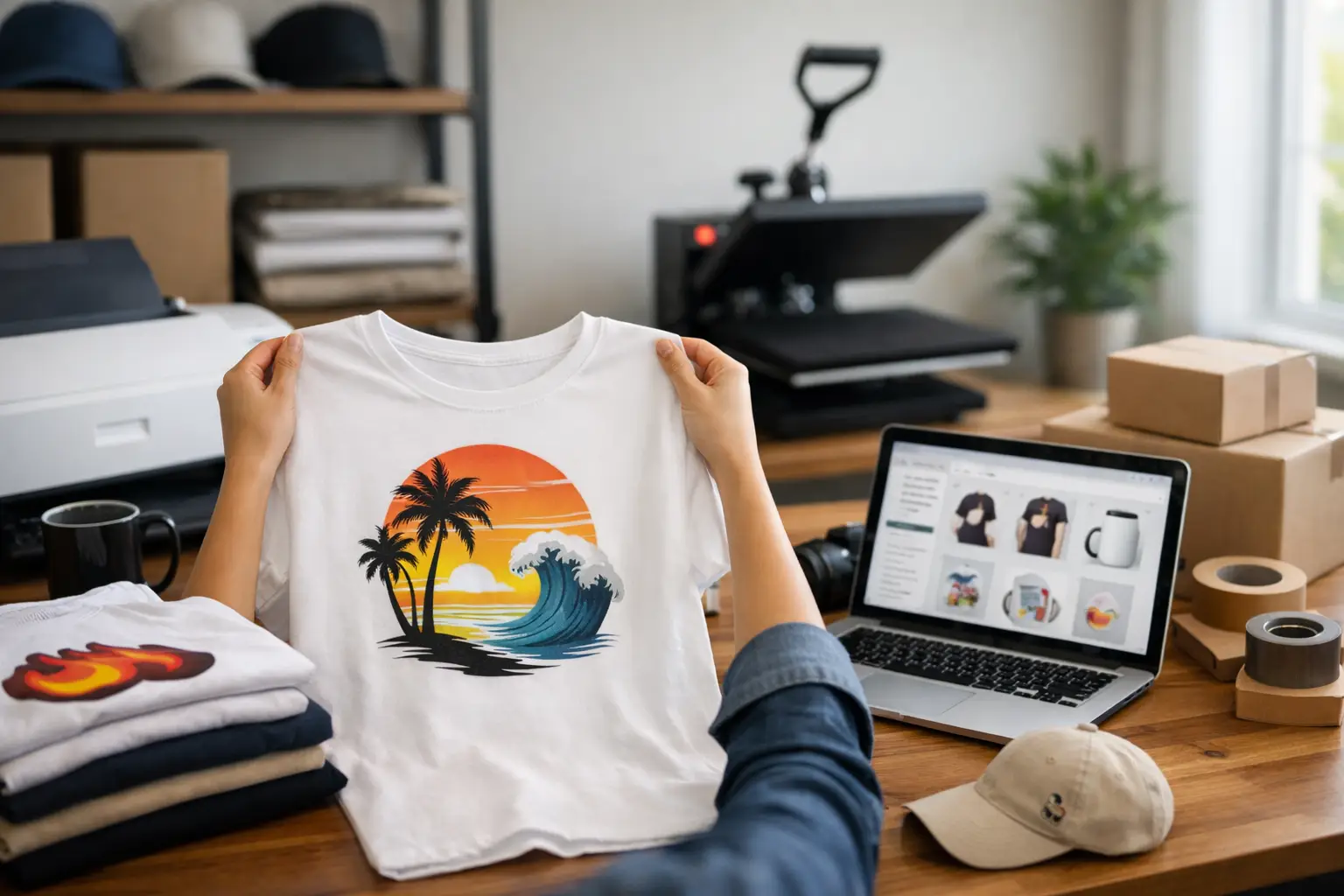
You can launch a shop in a weekend, upload a few designs and feel like you have a business by Sunday night. That is exactly why a print on demand side hustle appeals to so many people. The setup feels simple, the risk looks low, and you do not need to hold stock in your spare room. But easy to start does not always mean easy to grow.
That is the real question here. Not whether print on demand works in theory, but whether it works well enough as a side income strategy for someone with a job, limited time and no interest in wasting months on guesswork.
What a print on demand side hustle actually is
Print on demand is a business model where products are only made after a customer places an order. You create the design, upload it to a platform or connect it to an online shop, and a fulfilment company prints and ships the item for you. Typical products include t-shirts, mugs, tote bags, hoodies, mobile phone cases and wall art.
For side hustlers, the attraction is obvious. You do not buy inventory upfront, you do not package orders yourself, and you can test ideas without a large budget. Compared with buying wholesale stock, it is a lighter way to start.
The catch is that low barriers attract a lot of competition. If anyone can open a shop quickly, plenty of people will. That means success usually comes down to product choices, niche selection, design quality and consistent testing rather than simply being present.
Why it appeals to busy people
A lot of online business models fall apart when you try to fit them around a full-time job. Service work depends on your hours. Reselling can mean storage, post office runs and awkward customer issues. Content businesses often take a long time before they make anything.
A print on demand side hustle sits in a more manageable middle ground. Once your listings are live, fulfilment is largely automated. That makes it attractive if you want something that can keep running while you are at work, commuting or getting on with family life.
It also suits people who want to build digital assets slowly. A good design can keep selling for months, sometimes longer, without you touching it. That does not make it passive, but it does mean your effort is not tied directly to every pound earned.
The biggest advantage – low upfront risk
This is where print on demand stands out. You can start with a small budget, especially if you already have basic design skills or are willing to keep your first products simple.
Your main costs are likely to be design tools, marketplace fees, samples if you order them, and possibly a shop subscription depending on the route you choose. That is far less risky than buying 200 printed t-shirts and hoping they sell.
For beginners, that matters. A side hustle should not create financial pressure before it has proved itself. Print on demand gives you room to test demand before putting serious money behind it.
The part people underestimate
The business is simple. Getting noticed is not.
This is where many beginners get stuck. They spend time setting up products, choose generic designs, then wait for traffic that never really arrives. The issue is not usually the platform. It is the lack of a clear angle.
A broad shop selling random slogan tees rarely goes far. A focused shop aimed at a specific audience has a better chance. That could mean products for dog owners, cyclists, teachers, gardeners, new mums, local pride, hobby communities or workplace humour. The more defined the buyer, the easier it is to create products that feel relevant.
You do not need to reinvent design. You do need to understand who would actually want to wear, carry or display what you are selling.
How much can you realistically make?
This depends on your niche, pricing, traffic source and how many products you test. Some people make beer money. Some build a meaningful second income. Most fall somewhere in between.
Profit margins are one of the weaker parts of print on demand. Because a third party handles printing and fulfilment, your base costs are higher than if you printed in bulk yourself. That means you may only make a modest profit on each sale unless you price carefully or sell higher-value items.
A £20 t-shirt does not mean £20 profit. After product cost, platform fees, payment processing and possible advertising costs, the actual margin can be much smaller. That is why volume, smart product selection and strong positioning matter.
If your goal is a quick extra £200 to £500 a month, print on demand can be realistic. If your goal is to replace a full-time salary fast, it is usually the wrong expectation. It can grow, but it often starts slowly.
Best routes for beginners
There are two common ways to approach this.
The first is using an online marketplace where traffic already exists. This is simpler because you do not need to build your own audience from scratch, but you are competing directly with many other sellers and working within the platform’s rules.
The second is running your own shop connected to a print provider. This gives you more control over branding, customer experience and long-term business value, but it also means you need to generate traffic yourself through social content, paid ads, email or another channel.
For most beginners, starting where buyers already are is the easier way to learn. Once you know what sells, building your own shop becomes more attractive.
How to make a print on demand side hustle more likely to work
Start narrow. One defined niche beats a general store almost every time. You want products that feel made for a certain type of person, not for everyone vaguely.
Keep your first designs simple and readable. A lot of products fail because they are cluttered, hard to read or trying too hard to be clever. Clear beats complicated.
Test more than one product type, but do not scatter your effort. If a design idea works on a mug, tote bag and sweatshirt, that is useful. If you create 40 unrelated products in week one, you are probably avoiding strategy.
Use mock-ups that look believable. Presentation matters. If the product image looks cheap or unrealistic, buyers will assume the item is too.
Pay attention to seasonality. Print on demand often performs well around gifting periods, holidays, events and niche-specific occasions. Planning ahead gives you a better chance than reacting late.
Most importantly, treat it like a business, not a creative dumping ground. You are not uploading designs for personal expression alone. You are trying to match products to buyers.
Common mistakes that waste time
One mistake is choosing a niche purely because it seems popular. Big markets are not automatically good markets. They can be overcrowded and expensive to compete in. A smaller niche with a clear identity can be more profitable.
Another is relying on poor-quality AI-generated designs without editing or direction. Buyers can spot lazy work. Even if you use tools to speed up production, taste still matters.
A third is quitting too early. Many shops fail because the owner uploads ten products, gets little response and assumes the model is broken. In reality, they have not tested enough ideas or given themselves enough time to learn what buyers respond to.
The opposite problem also happens. Some people keep uploading without reviewing performance. More products do not fix weak positioning. At some point, you need to look at what is getting views, clicks and sales, then adjust.
Is it still worth starting now?
Yes, but only if you approach it with realistic expectations.
Print on demand is not dead. It is just more mature than it used to be. The easy wins are rarer, and generic products are less likely to get traction. But there is still room for sellers who understand an audience, create relevant designs and stay consistent long enough to improve.
That makes it a decent option for people who want a low-risk online business with flexible hours. It is especially useful if you like product ideas, branding and simple digital tools, but do not want to manage stock or offer client services.
If you hate testing, dislike visual products or want fast, predictable income, another side hustle may suit you better. A print on demand side hustle rewards patience and iteration more than urgency.
For Side Line Profits readers, that is probably the best way to think about it. Not as a magic income stream, but as a practical, low-cost business model that can fit around real life if you give it a proper strategy.
Start small, choose your niche carefully, and let the first version be simple. A side hustle does not need to look impressive on day one. It just needs a fair chance to become useful.