
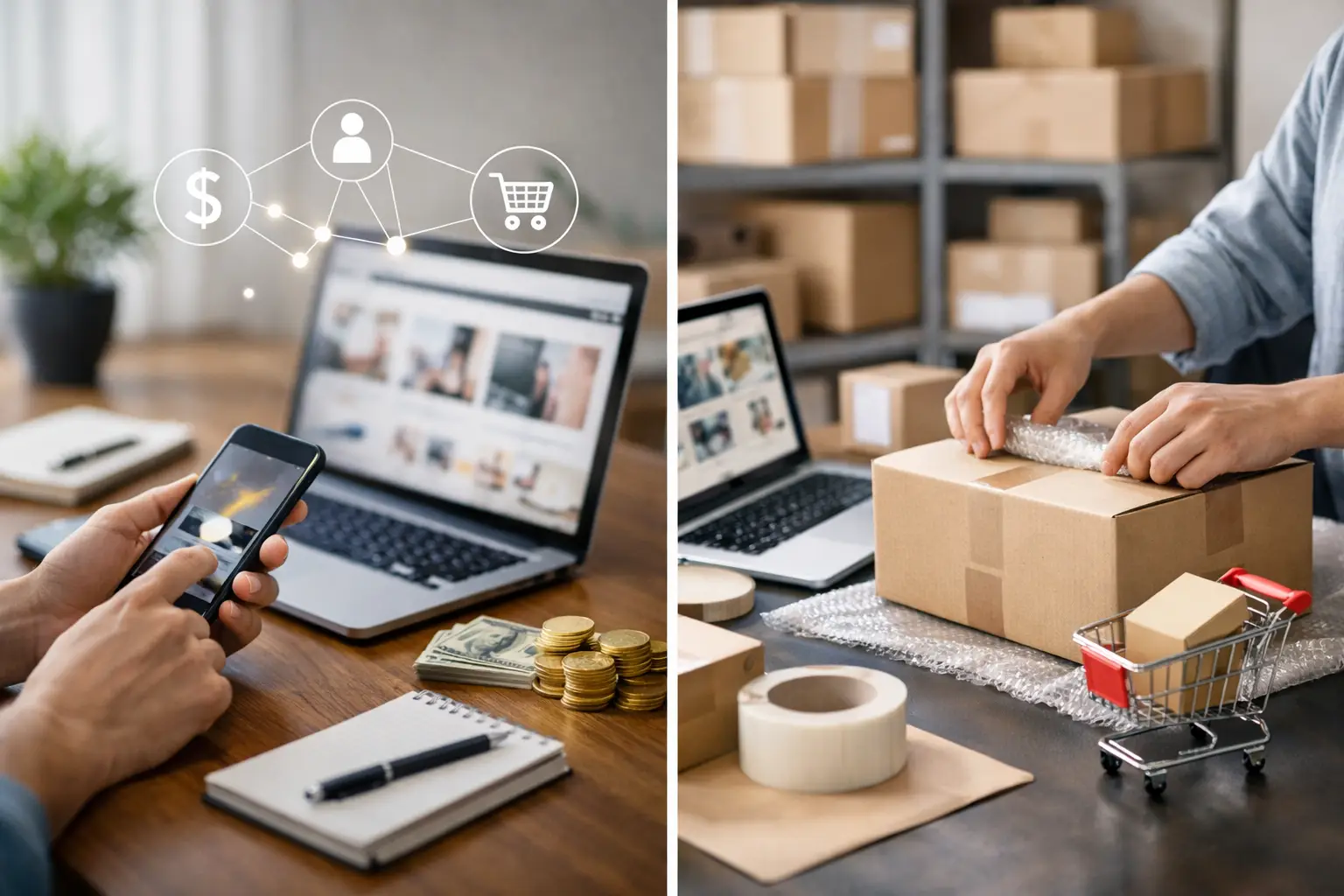
Most people asking about affiliate marketing vs dropshipping are really asking a simpler question: which one gives me the best chance of earning extra money without turning my evenings into a second full-time job?
That is the right question to ask. Both models can work. Both are popular. And both get oversold by people who make them sound easier than they are. If you want a side hustle that fits around work, family and normal life, the better choice depends less on hype and more on how you want to spend your time, what level of risk you can handle and how quickly you need to see results.
Affiliate marketing vs dropshipping: the simple difference
Affiliate marketing is about promoting someone else’s product or service and earning a commission when a sale or lead comes through your referral. You do not handle stock, fulfil orders or deal with customer support for the product itself.
Dropshipping is an ecommerce model where you run an online shop and sell products without holding inventory yourself. When a customer orders from your shop, a supplier ships the item directly to them. You control the storefront, pricing and customer experience, but you also carry more responsibility.
At a glance, affiliate marketing is usually lighter and lower risk. Dropshipping gives you more control but also more moving parts. That trade-off matters.
Which is easier to start?
For most beginners, affiliate marketing is easier to start well.
You can begin with a content platform such as a niche website, email list, YouTube channel or social media presence. Your main job is to attract attention and recommend products that fit your audience. The setup can be fairly lean, especially if you already enjoy writing, reviewing tools or sharing useful advice.
Dropshipping asks more from you at the start. You need a store, product selection, supplier research, pricing, product pages, policies and a basic understanding of conversion. Even if software makes the setup look simple, the business itself is not simple. You are still running a shop.
If your time is tight and you want a model you can build step by step, affiliate marketing tends to be the more forgiving option.
The real cost difference
A lot of people choose based on potential profit and ignore the cost of getting there.
Affiliate marketing can be started on a relatively small budget. You may pay for a domain, hosting, software tools or content creation support, but there is no need to buy stock. If you use organic traffic strategies like SEO, Pinterest, YouTube or email, your financial risk stays fairly contained. The bigger investment is time.
Dropshipping often needs more upfront spending than people expect. You may need to pay for ecommerce software, apps, creative assets, sample products and, in many cases, paid advertising. That last part is where the pressure builds. Many dropshipping shops rely heavily on ads to get traction, and ad costs can rise quickly if your product, offer or targeting is off.
So if your budget is modest, affiliate marketing usually gives you more room to learn without burning through cash.
Affiliate marketing vs dropshipping on risk
If you are trying to build a side income while keeping your day job, risk matters as much as reward.
Affiliate marketing is lower risk because you are not responsible for fulfilment, refunds, damaged items or shipping delays. If the merchant handles the product badly, that can still affect your credibility, but the operational burden stays with them.
Dropshipping carries more operational and reputational risk. The customer buys from your shop, not from the supplier they never see. If shipping takes too long, a product arrives damaged or tracking goes missing, you are the one answering the emails. That is manageable, but it is not passive and it is not always side-hustle friendly.
This does not mean dropshipping is a bad model. It means you should go into it with your eyes open. Control and margin potential often come bundled with hassle.
What about profit potential?
This is where things get less black and white.
Affiliate marketing can produce strong margins because you do not handle stock or fulfilment. Once content ranks well or your audience grows, one article, video or email can keep generating commissions over time. That makes it attractive if you want to build a digital asset rather than chase one-off sales every day.
The downside is that your earnings are tied to somebody else’s programme. Commission rates can change. Offers can disappear. Conversion rates are affected by the merchant’s landing page, pricing and checkout experience, none of which you control.
Dropshipping gives you more control over pricing, branding and customer journey. If you build a strong shop with a good supplier and a product that people genuinely want, your upside can be significant. You are not relying on a commission percentage set by someone else.
But profit is not just revenue minus product cost. You need to factor in ad spend, returns, payment fees, app costs and the time spent handling support. A dropshipping store can look profitable on the surface and still be underwhelming once everything is counted properly.
The time question most people miss
A side hustle has to fit your actual week, not the week you imagine when you are feeling motivated on a Sunday evening.
Affiliate marketing usually rewards consistency over intensity. You publish useful content, build trust, improve rankings, grow an audience and let compounding do some of the work. It can be slow at the start, but it suits people who want to chip away at something in a structured way.
Dropshipping often demands faster reactions. You may need to test products, adjust ads, deal with supplier issues and respond to customers promptly. It can feel more immediate, which some people like, but it can also pull you into daily fire-fighting.
If you only have a few focused hours each week, affiliate marketing is often easier to sustain. If you enjoy trading speed for control and can handle more day-to-day management, dropshipping may suit you better.
Skills you need for each model
Neither route is magic. They just reward different strengths.
Affiliate marketing suits people who are willing to learn content, audience building, search intent, copywriting and trust-based selling. You need patience because results often arrive later than beginners hope. If you like teaching, reviewing, comparing products or solving problems for a specific audience, that is a strong fit.
Dropshipping suits people who are comfortable with ecommerce, product testing, paid traffic, pricing psychology and customer service. You need to make decisions quickly and read numbers with a cool head. If you enjoy building stores and testing offers rather than producing content, that can be a better fit.
A lot of side hustlers assume they should choose whichever model sounds more profitable. A better approach is to choose the one that matches how you naturally work.
Who should choose affiliate marketing?
Affiliate marketing is usually the better option if you want low startup risk, prefer flexible hours and like the idea of building a long-term digital asset. It is especially useful if you already have knowledge in a niche people spend money in, such as software, finance, fitness, careers, hobbies or business tools.
It also makes sense if you are not keen on handling customer complaints or managing suppliers. For busy professionals in the UK looking for something practical outside work, this is often the cleaner starting point.
Who should choose dropshipping?
Dropshipping makes more sense if you want to run a proper ecommerce business, do not mind customer service and are willing to test offers aggressively. It can suit people who are comfortable spending money to gather data and improve performance.
It is less ideal if your budget is tight or your schedule is unpredictable. A shop needs attention, and neglect tends to show quickly.
The best choice for most beginners
If you are starting from scratch and want the more realistic side-hustle path, affiliate marketing usually wins.
Not because it is effortless. It is not. But it is simpler to learn, cheaper to test and easier to fit around a full-time job. It gives you a way to build content and traffic that can keep working after the initial effort. That matters if your goal is not just extra cash this month, but a business that becomes more stable over time.
Dropshipping can still be the right move if you want an ecommerce route and are prepared for the operational side. Just do not choose it because somebody online made it sound fast.
The smartest move is to pick the model that matches your budget, energy and attention span, then commit long enough to get good at it. A side hustle rarely fails because the model is impossible. More often, it fails because the model did not fit the person trying to run it.
If you want something you can build steadily without adding chaos to your week, keep it simple, start where the risk is lower and give yourself space to improve as you go.